---
description: "What the HardBasis Proof of Reserves page proves, what it deliberately leaves out, and how staleness and the withdrawal covenant work."
---
# Trust & Proof of Reserves
HardBasis holds customer sats. The honest way to say that is: while your balance
is idle it sits in your own Spark leaves and you can exit unilaterally, and the
moment you post margin those sats move to HardBasis and your position becomes a
claim on this engine.
**Self-custodial funds, custodial positions.** The Proof of Reserves page is
where the second half of that sentence is made checkable.
Open the live testnet Proof of Reserves →
## What the page proves
**Reserves against liabilities.** The engine continuously reconciles what it
holds on the settlement rail against what it owes customers, and publishes the
result along with the drift between the two. A reconciliation that does not
balance is published as not balancing: the page shows the drift rather than
hiding it.
**A liability root you can be checked against.** Customer balances are summed
into a Merkle root that is published with each reconciliation. From your own
account you can obtain an inclusion proof and verify, locally and without trusting
the response, that your balance is one of the numbers inside that published
total. This is what stops a venue from publishing reserves that look fine because
some liabilities were left out of the sum.
**A history, not a snapshot.** The page carries the recent reconciliation
history, so a single clean reading is not the whole story you get.
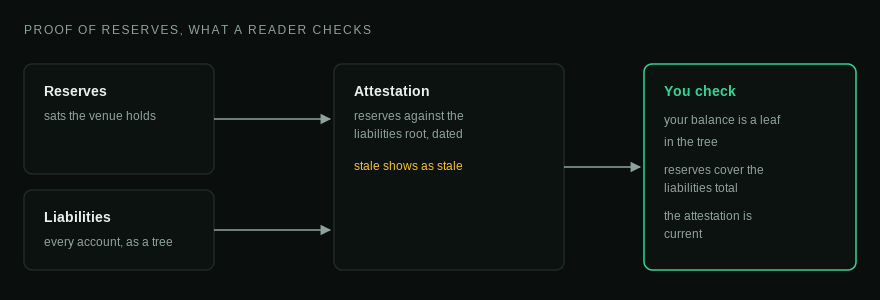
The venue publishes its reserves and a tree of every account's liabilities, and attests the one against the other with a date; a stale attestation shows as stale. You check that your balance is a leaf in the tree, that reserves cover the liabilities total, and that the attestation is current.
## What the page deliberately does not show
It does not publish a live, itemised inventory of the vault's positions and
hedges. That is not a transparency figure; it is the venue's trading position,
and publishing it in real time would let anyone trade against the pool that backs
customer positions, at customers' expense. Proof of Reserves answers "are
customer liabilities backed", which is the question that protects you. The vault's
book is not part of that answer.
## Staleness is shown, not smoothed
A reconciliation figure that was true an hour ago and still renders with live
confidence is a false statement, not a stale one. So the page marks itself:
- each reading carries its age, and the page declares itself **stale** once that
age passes the threshold the server itself publishes;
- when stale, the figures are visibly marked as such rather than being displayed
as current;
- a figure that is genuinely absent renders as an em dash, never as zero, never
as the last value that happened to be handy.
That doctrine is not specific to this page. It is how every live figure across
HardBasis is required to behave: a live figure must either be live or look dead.
## The withdrawal covenant
Withdrawing your free balance works in every mode the engine can be in. Not as a
matter of policy or good intentions: the withdrawal paths in the engine are
tested to have no dependency on any risk, compliance, or referral control, and
the build fails if one is ever introduced.
Claiming a referral reward is **not** a withdrawal. It moves sats into your free
balance; withdrawing them is the separate step that carries the covenant. See
[Refer & Earn](/refer#accrue-vest-claim).