

MSTR-SATS explained
MSTR-SATS is a perpetual contract on one share of Strategy (Nasdaq: MSTR), quoted in sats and settled in sats. One contract is a hundredth of a share: its shareScale is 0.01, so 100 contracts are one share. The price is how many sats one share is worth right now.
That is the whole product. The rest of this page is what follows from it.
The number
The index is two public prices divided:
P_sats = round_half_even( MSTR_usd / BTC_usd × 100,000,000 )Worked example, from Strategy's own investor briefing of 2026-10-04: MSTR at $158.28 and bitcoin at $84,289.
158.28 / 84,289 × 1e8 = 187,782.51 → 187,783 sats per shareSo one share of Strategy was worth 187,783 sats. The same briefing reports that each share was backed by 187,787 sats of net bitcoin. The market was paying almost exactly the bitcoin.
Those two numbers are the trade. The venue serves the first one. The second one is yours to look up and apply.
Why price it in sats
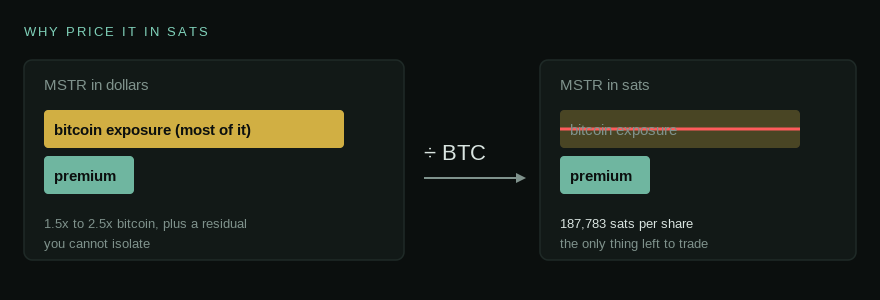
Strategy holds about 850,000 BTC. Its stock moves with bitcoin, roughly 1.5 to 2.5 times as hard. If you trade MSTR in dollars, most of what you are trading is bitcoin, and most of what you are paying for is bitcoin volatility.
Price the share in sats and bitcoin cancels out. What is left is the one thing that is specific to Strategy: how much the market pays for a share compared with the bitcoin behind it. People call that the premium, or mNAV. MSTR-SATS is the market for it.
Three moves

Long 3 shares (300 contracts) at 187,783 sats, 5x leverage. Margin 112,670 sats.
| Scenario | MSTR | BTC | New price | Your PnL |
|---|---|---|---|---|
| Both up 10% | +10% | +10% | 187,783 | 0 sats |
| Bitcoin up, stock flat | 0% | +10% | 170,711 | −51,216 sats |
| Stock up, bitcoin flat | +20% | 0% | 225,339 | +112,668 sats |
Row one: bitcoin and Strategy rallied together. In dollars you made money. In sats, nothing happened to the premium, and nothing happened to your position.
Row two: bitcoin rallied and the stock did not follow. Each share now buys less bitcoin. The premium compressed. A long loses.
Row three: the stock rallied on its own. The premium expanded. This is the move the contract exists for.
If you want to bet that bitcoin goes up, trade BTC-USD. If you want to bet that Strategy's shares will be worth more bitcoin, or less, this is the market.
Leverage, margin, liquidation
MSTR-SATS is a plain linear contract. Notional is contracts × shareScale × price, in sats. Initial margin is notional divided by leverage. Maintenance margin is a percentage of notional. Liquidation is where your margin plus unrealized PnL would fall to the maintenance level.
From the example: long 1 share (100 contracts) at 188,000 sats, 5x, maintenance 2 percent. Margin 37,600 sats. Liquidation at 153,470 sats, 18.4 percent below entry. For a short the same formula runs the other way.
Everything is integer sats. The tick is 1 sat. Quantities are whole contracts of a hundredth of a share each, so you can trade 0.01 share at a time.
Funding
Funding keeps the perp near the index. It is the premium of mark over index, clamped, paid every interval. Longs pay when the perp trades above the index; shorts pay when it trades below.
There is no interest-rate term. On a dollar perp that term comes from the gap between dollar rates and the asset's lending rate. On a sats-quoted contract there is no honest input for it, so it is zero by contract type, and the instrument says so.
When the market is CLOSED, and when it is stale
Nasdaq is open 09:30 to 16:00 Eastern, Monday to Friday. Bitcoin never closes. Outside the Nasdaq session the stock does not print, and a sats price made from a live bitcoin leg over a stale stock leg would be a number the venue knows is wrong. So the market is CLOSED outside the session, and no price is served. Positions and margin are untouched; nothing executes.
Inside the session, each leg of the index has its own freshness rule. If either leg is stale, the index is stale, no price is served, nothing fills or liquidates, and the instrument names the leg (equity, btc, or both). The venue never carries a last-good price forward. Withdrawals of free balance work in every state.
What the venue does not tell you
The venue does not publish mNAV, bitcoin per share, premium or discount. Those depend on which share count you use, how you treat convertible debt and preferred stock, and whose balance sheet date you take. For Twenty One Capital the same instant reads 1.37 on a basic count and 0.73 fully diluted. Any number the venue picked would be an opinion served as a fact.
Price in sats is the one number with no method in it. You apply the denominator you believe.
Risks that are specific to this market
- The premium moves about as much as bitcoin does. Stripping bitcoin out of MSTR does not leave a quiet spread. It leaves a second bitcoin-sized risk, uncorrelated with the bitcoin you hold as collateral.
- Gaps at the open. Bitcoin moves all night; the stock catches up at 09:30. The first prints of the session can be far from the last prints of the previous one, and the market reopens at the new price.
- Corporate actions. A share issuance, a buyback or a change to Strategy's capital structure changes the bitcoin behind each share. The contract tracks the share's price, not its backing.
- Thin books early. A new market has less depth than BTC-USD. Size accordingly.
The treasury board
MSTR-SATS is the first of a set. XXI-SATS (Twenty One Capital, which has traded below the value of its bitcoin) and ASST-SATS (Strive, which is accumulating) use the same contract. Together they let you trade one treasury company against another in one margin pool.
Contract specification: see linear_sats contracts.